
 Technics
 Audio & Hifi
 ALBEPRO Services
 Cables
 DJ Gear
 Vinyl
Vinyl
0
Your Cart
Technics SU-R1000 Reference Class Amplifier Silver


Hover over an image to enlarge


Technics SU-R1000 Reference Class Integrated Amplifier – Silver
Technics’ Old and New Heritage
The SE-R1, the first Reference Class stereo amplifier introduced by Technics in 2014, was equipped with many new and original digital technologies. Examples include LAPC (Load Adaptive Phase Calibration), which achieves the ideal impulse response, and the JENO (Jitter Elimination and Noise-Shaping Optimisation) Engine, which enables extremely precise, high-quality PWM signal processing with minimal jitter. The SE-R1, with its accurate audio quality and spacious soundstage, was warmly welcomed by the market and marked the beginning of the digital amplifier era.
The SL-1000R turntable system, introduced in 2018, combined digital control technology with high-level traditional analogue technology. In addition to its incredibly powerful torque and precise, smooth rotational performance, this turntable was exceptionally quiet and delivered a sound dynamic unmatched by any conventional record player. Building on what has been achieved since the rebirth of the Technics brand in 2014, how these products have been received by the Hi-Fi market, and the results of R&D focused on improving sound quality through digital technology, Technics now introduces the SU-R1000. With this integrated amplifier, digital amplifiers evolve to new heights.

The Development of the Technics SU-R1000

The new amplifier from Technics is fundamentally based on digital technology. Most high-end audio amplifiers are analogue amplifiers and can boast a long history. The technologies applied to improve their sound quality, focusing on areas such as circuit systems and component development, are generally regarded as well established. For digital amplifiers, however, the designers believe there is still significant room for further development. The rapid technological advances of recent years have enabled extremely precise signal processing that analogue systems cannot provide.
Considering that today’s mainstream music sources are digital, digital signals should ideally be processed in their original digital format. In addition, devices such as AD converters are also advancing, making highly accurate digital signal processing of analogue music sources possible. Under these circumstances, Technics has focused on the development of digital amplifier technology since 2014. During the development of the Reference Class product Technics SU-R1000, Technics adopted the following technological approach.
Improvement of Digital Amplifier Technology
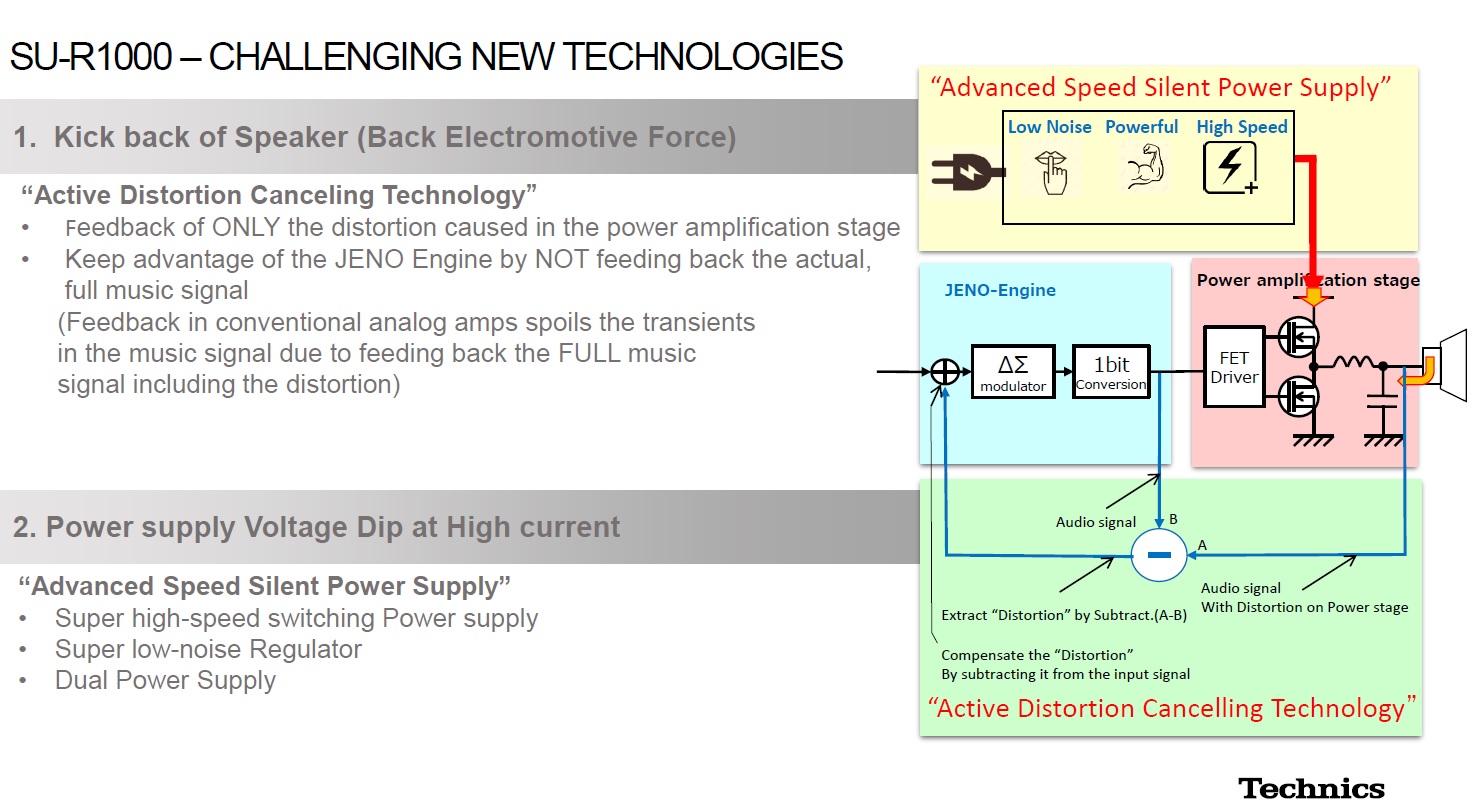
Technics has now developed ADCT (Active Distortion Cancelling Technology), in addition to the technologies previously created by the company that optimise the advantages of digital amplifiers, such as LAPC and JENO. ADCT achieves a further enrichment of sound quality by eliminating distortion generated in the power stage by the speaker’s counter electromotive force and by fluctuations in the power supply voltage.

MM/MC Phono Input, Technics’ New Option
There are still many enthusiasts of analogue records, and they represent an important market segment for Technics. The Technics SU-R1000 is equipped with an Intelligent Phono EQ, which uses digital technology to achieve an accurate equaliser curve and delivers high sound quality by improving the crosstalk performance of the connected cartridge and enhancing the frequency characteristics determined by the matching of the cartridge and phono equaliser. This is accomplished with the aid of a special calibration vinyl record supplied together with the amplifier.
Intelligent Phono EQ
The Intelligent Phono EQ in the Technics SU-R1000 makes use of DSP technology that Technics acquired through the development of LAPC. This made it possible to achieve a high sound quality that cannot be realised with analogue Phono EQ systems. This technology consists of three parts:
- Accurate EQ Curve
- Crosstalk Canceller
- Response Optimiser
These functions can be switched on or off according to the user’s preference.
1. Accurate EQ Curve
The Accurate EQ Curve is made possible by a hybrid analogue-digital system. The high-gain low-pass filter (LPF) performs the analogue processing, while the high frequencies are boosted after A/D conversion. The use of the 40 dB LPF in the analogue domain suppresses bit loss during digital filter processing, while high frequencies are boosted with high precision in the digital domain, enabling a high signal-to-noise ratio.


3. Response Optimiser
This function measures the frequency characteristics of the installed cartridge using a TSP (Time Stretched Pulse) signal recorded on the supplied calibration record and corrects characteristic distortion. It corrects the effect of impedance matching between the cartridge and the phono equaliser in order to reveal the cartridge’s true sound quality. This technology is designed to improve sound quality through a switch in the highly sensitive phono input stage, helping to eliminate potential noise.

Equipped with Various High Sound Quality Technologies
JENO (Jitter Elimination and Noise-Shaping Optimisation)
Jitter is a major cause of distortion in digital systems and results from incorrect timing in the master clocks used during digital-to-analogue conversion. To eliminate the reduction in sound quality caused by jitter, Technics developed an original jitter reduction circuit. This circuit consists of a clock generator in the noise-shaping stage to reduce low-frequency jitter, combined with an ultra-precise sample rate converter for suppressing high-frequency jitter.
In this way, jitter is ideally reduced across the entire frequency range. This works together with the original ultra-precise PWM (Pulse Width Modulation) conversion circuit, in which the noise-shaping speed, degree, re-quantisation number, and PWM gradation are optimised to convert high-resolution signals into PWM without compromising the dynamic range.
Through these technologies, the digital amplifiers from Technics are able to reproduce the natural and delicate nuances of music.

Advanced Power Supply System
Advanced Speed Silent Power Supply
The Technics SU-R1000 uses a switching power supply to ensure a stable delivery of the voltage and current required by the digital amplifier. In a conventional switching power supply, the ON-time of the switching operation is controlled to stabilise the voltage, causing the switching frequency to vary depending on the load. This results in modulation noise that can affect sound quality.
The Advanced Speed Silent Power Supply eliminates this noise by fixing the switching frequency in the 400 kHz range. In addition, a Super Low Noise Regulator has been added in the output stage. This prevents a reduction in regulation performance caused by the fixed switching frequency and suppresses high-frequency noise.
The result is a highly responsive power supply that allows the digital amplifier to perform at its optimal level.


Battery-Driven Clock Generator
For a digital amplifier, improving the precision of the clock — which provides the critical timing information — is key to achieving high sound quality. However, noise from the power supply of the clock circuit is a major limiting factor.
The Technics SU-R1000 is equipped with a Battery Driven Clock Generator. Using a battery as the power source for the clock circuit eliminates the negative impact of power supply noise on the clock signal, enabling excellent sound image localisation and a clear expression of spatial depth.
GaN-FET Driver for High-Speed, Low-Impedance Power Devices
In the power stage of the amplifier, Technics has implemented a high-speed GaN (gallium nitride) FET driver with extremely low resistance. This allows a very powerful amplifier to be realised using a single push-pull configuration.
As a result, the length of the high-current signal path can be shortened, leading to excellent linearity regardless of output level.
Specs